The Employee Advantage in the Age of AI
BY Katie Chambers
|
July 01, 2026

AI is reshaping conversations across the workforce, but those conversations look very different depending on where you sit. A recent survey of 1,400 U.S.-based employees conducted by Stephan Meier, an author and professor at Columbia Business School, found that 76% of executives reported their employees were enthusiastic about AI adoption. But when those individual contributors were asked, only 31% expressed that enthusiasm. The fear of being “replaced” by AI continues to be very real.
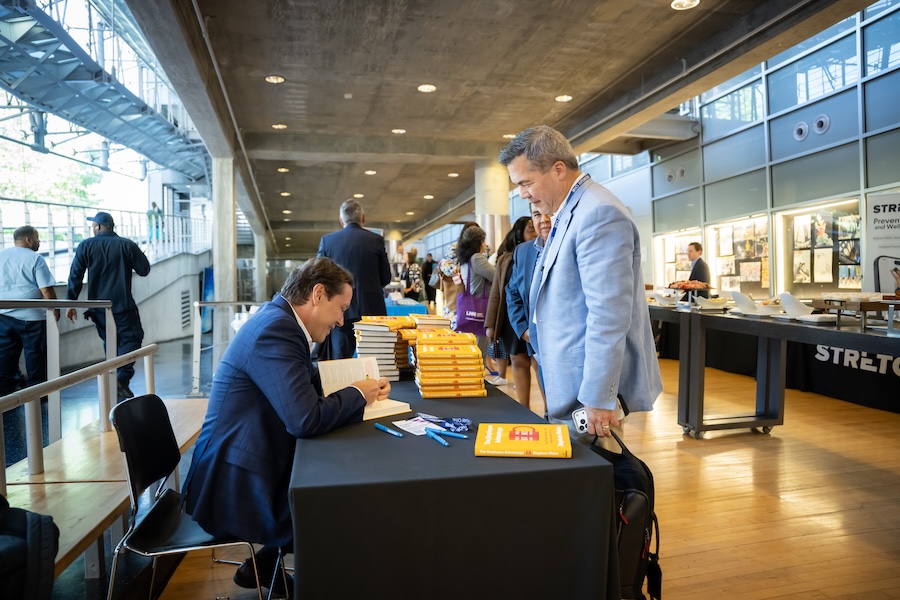
During a fireside chat at From Day One’s Manhattan conference, Meier shared how AI is less a technology challenge than a people challenge. Drawing on his research and recent book, The Employee Advantage: How Putting Workers First Helps Business Thrive, he explored what conversations leaders should actually be having about transforming their companies and what it takes to bring employees along in an era of relentless change.
Encouraging AI Adoption at Every Level
The survey results demonstrate that “there’s clearly a disconnect,” said moderator Cadie Thompson, executive editor at Business Insider. Meier notes that this “staggering” disparity between the C-Suite, middle management and lower-level employees is comparable in other questions, such as “Are you informed about AI?” and even “Is the organization employee-centric?” Meier says the gap speaks not only to a lack of employee data, as employers place greater value on customer data, but also to a broader issue of disconnect at the highest levels of leadership. “The reality of an executive with AI is very different from the reality of individual contributors,” he said.
Uncertainty is perhaps the primary contributor to employees’ distrust of AI. “Everybody feels it in their bones: the exponential growth, the fast-paced change, and uncertainty [are] just really, really bad for enthusiasm [and] being optimistic,” Meier said. Especially as many organizations are explicitly tying their layoffs to AI, “executives are talking about opportunity; employees are feeling something very different,” Thompson said. Meier says he is personally “very skeptical” about how many companies are actually firing people and replacing them with AI, using it as “just a good excuse” rather than acknowledging other issues like over-hiring or overestimating company growth.
Proper positioning in internal and external communication efforts is key. “It’s a change management program problem that we actually know a lot about [already],” Meier said. He suggests using the Five I’s of change management, which are also applicable to transparent communication regarding AI adoption:
1. Inform: Be explicit about what you are doing, when, and why.
2. Incent: Explain the potential value and benefits to the employees.
3. Involve: Give employees an opportunity to have a say in initiatives or at least provide feedback.
4. Inspire: Articulate the bigger vision behind the initiative.
5. Instruct: Provide training and upskilling opportunities tied to the new tools and goals.
The driver behind so many employers’ statements about AI, Thompson says, is efficiency, cost savings, and productivity. “Have we become too focused on what AI can save and not focused enough on what it can create?” she asked. Meier feels we have. Eventually, he says, AI will become commonplace, a great equalizer among companies that will all find ways to incorporate its productivity tools. “Differentiation [among competitors] comes from creating something new,” he said.
Using AI to Make Work Better
Thompson quoted Meier’s frequent refrain that “the goal shouldn’t simply be making work cheaper; it should be making work better.” Of course, we all experience work differently. That said, he boils employee engagement down to four simple motivators: purpose, autonomy, competence, and relatedness. How will AI impact those drivers? Meier predicts the most “at-risk” motivator is autonomy, since so many AI tools are tied to surveillance or may simply leave employees feeling disempowered. “I think you can use it in a way that kills those motivators or enhances them and really creates beautiful work and potential humanity unleashed… like [a] Renaissance version of whatever you’re doing.”
To reach that latter position of creative revolution, Meier says employers should focus on skill-building and implement enticing, achievable projects. “That’s what motivates people: having a task that is just right for their level. Around 40% of people quit because they don’t learn anything new,” he said. “AI can create something that is beautiful when it comes to skills,” such as implementing an algorithm to help identify the ‘just right’ task to keep an employee engaged and productive. “That’s what Netflix does. That’s what algorithms do really well: personalizing. You can apply that to those ‘just right’ tasks and those internal marketplaces that many companies are now using.”
The threat of AI in the workplace is not just literal but existential, as so many people find a sense of value and personal identity through their work. “That’s a challenge that we have to deal with,” Meier said, noting that employers and workers may need to devise other complementary tasks that require a human touch, or at least leave humans to focus on the higher-level complex thinking while AI handles the rest.
He also cautions against the fallacy of the “first-mover advantage,” noting that early adopters don’t necessarily end up with the best or smartest implementation of the product. “Just because companies can do something with AI, doesn’t mean they should,” Meier. “It should be intentional. Because we can do more, strategy becomes even more important.” He cites vibe coding as an example of an AI implementation that is easy and satisfying but often ultimately produces a mediocre product because it lacks a human expert at the helm. Asking employees for feedback and prioritizing their expertise will help employers implement AI in an impactful, sustainable way. “The companies that are intentional or really strategic are the ones that are going to win.”
Katie Chambers is a freelance writer and award-winning communications executive with a lifelong commitment to supporting artists and advocating for inclusion. Her work has been seen in HuffPost, Top Think, and several printed essay collections, and she has appeared on Cheddar News, iWomanTV, On New Jersey, and CBS New York.
(Photos by Josh Larson for From Day One)