Career Growth as a Key Ingredient for Employee Retention and Engagement
BY Carrie Snider
|
December 08, 2025

For decades, career advancement followed a predictable path: work hard, earn the next title, secure the next raise. But that’s no longer what most experience anymore. Ralph Nader, SVP and head of talent at IPG Mediabrands, put it plainly: “There are certain organizations or certain functions where it’s really easy to outline a very traditional career ladder. That said, that’s not reality for most.”
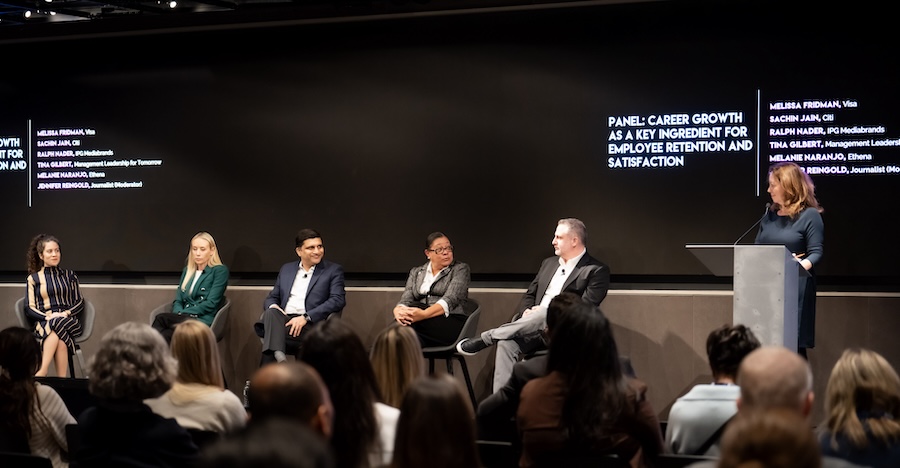
Nader spoke on an executive panel discussion at From Day One’s Midtown Manhattan conference. Leaders explored one of the most critical drivers of employee engagement and retention: career growth.
Nader encourages employees and leaders alike to rethink growth through a broader, more flexible lens. Inspired by the now-common “career jungle gym” idea, he emphasizes that sideways, diagonal, or even backward moves can be just as valuable as upward ones.
“Stop thinking about the next promotion, stop thinking about the next paycheck,” he said. “Really think about what skills you have now, what skills are needed for the dream job that you want.” The same goes for companies; they should expand to focus on skill-building for employees.
For employees feeling stuck simply because a promotion isn’t available today, Nader offers both reassurance and practicality. Progress doesn’t always come in the form of a new job description—but it can come through strategically building abilities that position you for the next opportunity.
Closing the Skills Gap for a Post-Pandemic Generation
For Tina Gilbert, VP of employer offering at Management Leadership for Tomorrow (MLT), the emerging workforce is shaped by experiences unlike any generation before it. As both a talent leader and a parent of college-age daughters, she has seen firsthand how Covid disrupted key developmental years.
MLT’s mission, Gilbert says, is to help employers understand this shift while preparing young professionals to succeed. Many students missed out on traditional developmental experiences, from in-person communication to navigating professional environments. “We’re trying to help young people understand some of the skills that might have been not as well developed,” Gilbert said. At the same time, she emphasizes that the new generation brings powerful strengths of its own, including “a level of understanding, of empathy and just general curiosity.”
The challenge and opportunity lie in reconciling what businesses expect with what young talent is prepared to deliver. This requires intentional design. Gilbert described the need for a clear and accessible “playbook” that explains expectations, models relationship-building, and outlines how to engage successfully in professional settings.
“What are you writing down for them to read?” she asked. “What are those relationship-building skills that you are working on, and how are you delivering that?”
Coaching and community are essential. Young employees won’t simply absorb these skills passively; they need support structures. Organizations must ensure “the coaching and then their peer connections” are in place to reinforce learning.
Career Growth Through Learning
For Sachin Jain, managing director and global head of talent strategy at Citi, the foundation of a successful career can be summed up in a single word: learning. Throughout his professional journey, this principle has shaped every move he’s made.
“Whenever I have an opportunity, I ask myself what will I be learning,” he said, “I would probably select a role which I’ve never done or which has the maximum amount of change from what I had done before.”
Learning is about intentionally seeking out unfamiliar environments, new responsibilities, and diverse perspectives. The greater the difference between one role and the next, the greater the growth. “That’s what provides you a different perspective,” he said. “That’s what provides you a different set of learning.”
This mindset, he says, allows employees to deliver better results, gain deeper satisfaction, and accelerate their long-term career trajectory. In practice, this means redefining how organizations and individuals think about advancement.
Jain notes that employees who grew up in a world of gaming, levels, and visible progress want a transparent view of where they stand. “They want to know what level they’ve achieved, and therefore, what is the gap to their next move–whether that be lateral or vertical.” Learning, then, becomes both the path and the product.
Building Skills, Not Just Job Titles
In today’s rapidly evolving workplace, career growth is no longer defined solely by promotions or job titles. Melissa Fridman, SVP and people business partner at Visa, North America, emphasizes that developing a robust set of skills is critical for long-term success.
“It’s becoming a lot more about what skills you have, versus what’s the particular job you had,” she said.
Fridman encourages employees to embrace opportunities that stretch their abilities, even if they seem less glamorous than their current role. Reflecting on her own career, she shared, “I thought somebody asked me this like years ago, and my answer has remained the same: say yes. I said yes to things I actually did not want to do. They weren’t as interesting. They weren’t as glamorous. But I guarantee you, when you look back, you will have taken something from that.”
The modern workforce also demands agility and adaptability, particularly as AI and other technologies redefine roles and responsibilities. Visa has even developed internal AI tools, like its Career Coach agent, to help employees identify skill gaps and create personalized development plans.
“It literally spits out, here’s what you should focus on in the next month, next three months, next six months, and what you should aspire for in a year,” Fridman said. The tools are designed not to replace human effort but to enhance it, freeing employees to focus on learning, creativity, and strategic problem-solving.
By prioritizing skill development over title advancement, employees can better navigate an unpredictable world while positioning themselves for meaningful and sustained success. “You could just keep sitting and waiting,” Fridman said, “but you’re going to be better off than when you started just sitting and growing in the same linear fashion.”
Asking Smart Questions to Grow
Growth in the workplace requires understanding the context behind decisions and using that insight to improve. Melanie Naranjo, chief people officer at Ethena, recalls a pivotal moment that reshaped her approach. Following a meeting, her CEO pulled her aside and “challenged me to reframe her argument around business impact, not just HR metrics,” said Naranjo. This experience taught her the importance of tailoring communication to her audience, ensuring that proposals resonate with decision-makers.
Naranjo emphasizes that learning also comes from asking the right questions. “Can you help me understand what would have needed to be true for you to say yes? What would you have wanted to see differently?” By probing thoughtfully, employees can gain clarity on expectations and identify actionable steps to improve performance. This approach transforms feedback from a one-way critique into a learning opportunity that guides career growth.
By initiating these conversations early, employees demonstrate engagement and collaboration while also aligning their personal goals with organizational objectives. Cultivating curiosity and seeking guidance empowers professionals to make better decisions and develop new skills.
Ultimately, career growth is the foundation for engagement, retention, and long-term success. Across industries, the message is the same: organizations that prioritize meaningful development, transparency, and adaptability create environments where employees thrive. By focusing on learning, skill-building, and strategic exploration, both individuals and companies can turn the uncertainty of today’s workforce into opportunity for tomorrow.
Carrie Snider is a Phoenix-based journalist and marketing copywriter.
(Photos by Josh Larson for From Day One)


