Redesigning Readiness for an Unpredictable Future
BY Kristen Kwiatkowski
|
November 23, 2026

The future of work is difficult to predict, but HR leaders can take steps to prepare their organizations for what comes next. That starts with building workforce readiness and ensuring teams can adapt to new challenges and priorities.
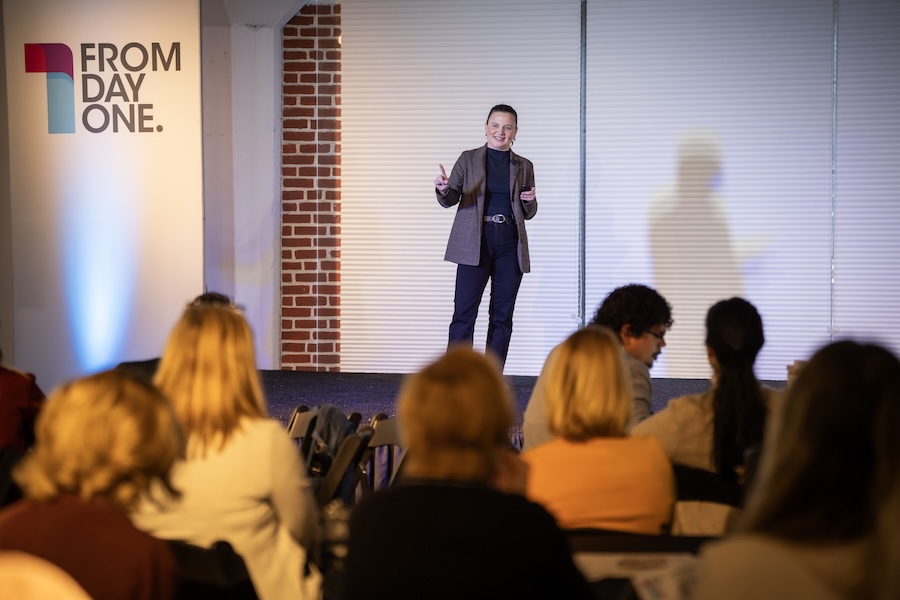
“In the talent development space, readiness is such a hot topic,” said Katelyn Sobel, solutions lead at digital coaching platform EZRA Coaching, at From Day One’s Los Angeles HR conference. “We’re talking about it all the time, building future-ready leaders, but the question really becomes, ‘What does that mean when we don’t really know what the future holds?’”
“AI has changed so much of what it means to work at an organization, to be a leader, and we are being asked to design for that future, but we don’t quite know what that is,” she said.
So, what is readiness? “At EZRA, we have looked across a lot of definitions around readiness, and what’s interesting is that many of the definitions are still very much about capability—what people know how to do,” said Sobel. “And our perspective, the behavioral science perspective, is that readiness is not just about capability, but it’s the ability to turn that capability into effective action when it matters.”
Defining readiness starts with two questions: Are we developing the right things, and are we developing leaders in the right way? Are we teaching the right skills, and are those skills accessible to the people who need them?
A leadership development program can help. But how do we create the ideal one, and what does it mean to be a leader? Sobel says distinctly human capabilities are critical behaviors for a leader for the future. Four focus areas include curiosity, discernment, humility, and connection.
Development is the next factor to consider. “Oftentimes, when we think about development, we think about training, we think about building capability, we think about what somebody knows,” said Sobel. “But if readiness is capability showing up when it matters, development needs to address what stops it from showing up.”
Opportunity and motivation are factors that must be considered when discussing development. When designing a program, it’s important to consider scale and depth. Timing is another crucial component. “People don’t experience development needs on a program schedule. People experience their development in the pockets that it’s happening.”
The EZRA team has gained feedback from more than 50 world-leading organization clients that tell them they want development that reaches more managers without becoming generic, brings the support closer to the moment of need, and goes beyond what general AI tools offer, to name a few factors.
Some may ask why we don’t give everyone AI. But a recent study between Boston Consulting Group and Harvard Business School showed otherwise. The study consisted of 758 consultants and then split them into two groups with one group having access to ChatGPT-4 and the other group having no access to AI tools. Both groups completed tasks, ranging from creative writing to a strategic business case, and researchers evaluated the outcome to see if the AI group outperformed the non-AI group.
The results showed that even though the AI group completed 12.2% more tasks, did it 25% faster, and had a 40% higher quality output, the downside was that their recommendation regarding the strategic business case was actually 19 percentage points less likely to be correct. “AI gave a really good steer, and it actually was very convincing, but oftentimes it pointed in the wrong direction,” said Sobel.
AI can extend support beyond a select few, sustain momentum, and make it easier to integrate learning into everyday work. But it has limitations: scaling can come at the expense of depth and context, ongoing support can become noise, and easy answers can crowd out judgment, reflection, critical thinking, and accountability.
AI and humans can, and should, work together in leadership development. EZRA Loop brings the two together through an always-on AI development system that also provides access to a human coach, combining the strengths of both.
When asked how to build readiness for an unpredictable future, Sobel says the key is to stop treating it as a one-time achievement to check off a list. Readiness isn’t just about what people know, but how well they can put that knowledge into practice.
“If we are going to rethink readiness, we also have to rethink what we’re teaching people and how we’re teaching it,” said Sobel. “So, with that, I don’t think that we can really tell our leaders exactly what they need to know for the future, but I do think that we can get a lot better at preparing them to meet it when the time comes.”
Editor’s note: From Day One thanks our partner, EZRA Coaching, for sponsoring this thought leadership spotlight.
Kristen Kwiatkowski is a professional freelance writer covering a wide array of industries, with a focus on food and beverage and business. Her work has been featured in the Bucks County Herald, Eater Philly, Edible Lehigh Valley, Cider Culture, and The Town Dish.
(Photos by Josh Larson for From Day One)

