Personalization Is the New Standard for Employee Well-Being
BY Katie Chambers
|
April 23, 2026

“We have people that are just starting out in their careers, parents, and people who are ready to retire. Some are salaried desk workers. Some are people out in the field and working hourly. There are people from across the world and many different nationalities,” said moderator Katie Johnston, reporter at the Boston Globe. All of these people come together at work.
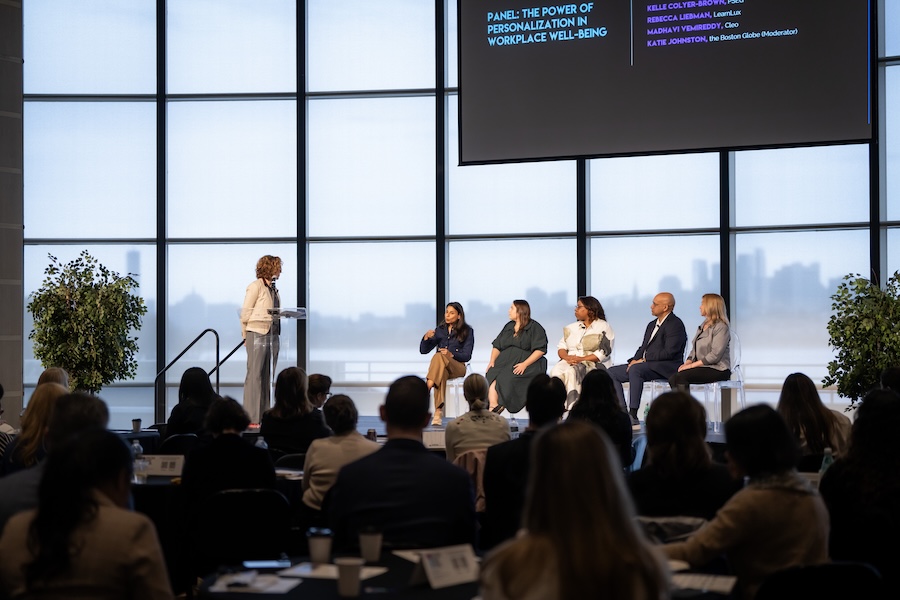
Thanks to data analytics technology, organizations have the opportunity to hone in on their specific needs to provide personalized benefits that leave them feeling engaged, supported, and seen. This was the topic of conversation during an executive panel discussion, moderated by Johnston at From Day One’s Boston benefits conference.
Benefits That Reflect Cultural Trends
Organizations are finding that more employees value meaningful work than ever before, especially post-pandemic. Aravind Menon, senior director of HR at Procter & Gamble, shares that his organization created a framework called the Employee Value Equation (EVE). “The primary focus of EVE is that employees at the core want to make an impact. They want to do meaningful work. They want to feel valued and rewarded,” he said.
The organization uses surveys and data analytics to get feedback on what is working for employees, and what isn’t. With more than 100,000 employees, having a way to gather opinions en masse is crucial. Guided by feedback data, Procter & Gamble began offering a health plan with more transparent pricing and flex benefits, such as optional classes or services tailored to employees’ needs.
Much of employee feedback, in one way or another, comes down to money. Offerings that support financial well-being have become integral to a well-rounded benefits package. “It is one of the only topics that touches every single person. Almost every single decision that you make on a daily basis,” said Rebecca Liebman, CEO and co-founder of LearnLux.
Financial well-being now goes beyond traditional retirement planning, Liebman says, and also includes preparation for emergencies, childcare, elder care, and general financial resilience as the cost of living skyrockets. A well-rounded package should offer personalization for every life stage and be paired with an internal communications plan that educates employees on how best to maximize the offerings.
Such messaging can be particularly challenging for large organizations like Securitas, which has employees of all ages spread across the globe in a variety of roles. “I might have one guard sitting behind a desk at an office building, another one standing at a bank. I might have a group of them at a stadium. In most cases, they’re generally not co-located,” said Amy Noelle, senior director, benefits, North America at Securitas. But they must nonetheless receive clear, personalized information.
Madhavi Vemireddy, CEO of Cleo, shares that in the U.S. alone, nearly 60 million people identify as caregivers and frequently hesitate to disclose this to their workplaces for fear of repercussions, such as being passed over for a promotion. “Family caregivers in the workforce, who are often women, deal with so many combinations of stressors: it could be pregnancy, parenting, menopause, elder care, [or] all of the above,” Johnston said. “How can employers identify who’s dealing with these issues and, before they get to the breaking point, what can they offer them?” Cleo works to help caregivers overcome the stigma and access the support they desperately need. “We’re supporting families across pregnancy, parenting journeys as well as adult caregiving, and we’re doing that holistically,” Vemireddy said.
Early intervention can help workers stay healthy—and that depends on transparency and psychological safety to combat the stigma. “We need to start talking about it more, just like how we’ve been talking about mental health in the workplace, about menopause in the workplace, we need to start talking about caregiving in the workplace,” Vemireddy said.
Sharpening Communications Strategies
Different workers may be receptive to different types of communication styles. But always, “there has to be an openness to the information before we decide on the delivery method,” said Kelle Colyer-Brown, head of office of accessibility programs at PSEG. Training internal stakeholders, in addition to engaging with outside vendors, is key. “We know that employees will go to the people that they talk to most often first, so ensuring that our managers have that information [is important],” she said.
In terms of delivery, “our salaried office-based employees are most likely going to go to things like our blogs, newsletters, and email blasts. That is extremely unlikely for our field employees,” Colyer-Brown said. Field employees might be more reachable through all-hands meetings, daily stand-ups, fairs, or even apps.
In difficult times, wellness offerings can help maintain engagement and retention. “This year, a lot of companies can’t give more money,” Liebman said. “So, they’re bringing in financial coaching as a benefit to help people understand what they can do with their paycheck. If we can’t give you more money, let’s empower you to make a plan for your life. And really, financial planning is just executing on the life that you want to live.”
Looking ahead, Colyer-Brown recommends relying on survey data to understand what employees are seeking, then consistently reviewing and meeting with current and prospective vendors to ensure those trends are addressed. If your current vendors don’t offer adequate support, consider “what’s my buy, borrow, build, mix to fill in some of those gaps? Am I going to build internal services? Am I going to do outreach to government entities? Am I reaching out to nonprofits?” she said. “If I need to spend money, at least I can go to my leadership and say, ‘I looked at our internal resources first before I asked you for a check. I’ve done my due diligence.’”
Katie Chambers is a freelance writer and award-winning communications executive with a lifelong commitment to supporting artists and advocating for inclusion. Her work has been seen in HuffPost, Top Think, and several printed essay collections, and she has appeared on Cheddar News, iWomanTV, On New Jersey, and CBS New York.
(Photos by Josh Larson for From Day One)