Smart Tools, Smarter Hiring: How TA Leaders Can Leverage Their Human Judgement
BY Grace Turney
|
April 09, 2026

Soha Kadam-Masudi recently sat down for a series of senior-level reference checks; and she barely picked up a pen. Microsoft Copilot recorded the calls, summarized the conversations, and handed her back something she hadn’t had in years of recruiting: her full attention. “It was such a meaningful conversation because I was focusing on the questions and what was actually coming back as a reference,” said Kadam-Masudi, director of talent acquisition for Aramark Canada.
That shift from administrative executor to thoughtful evaluator is exactly the evolution talent acquisition leaders are chasing right now. AI tools have moved well beyond the novelty stage and into the daily rhythms of recruiting, automating the repetitive and liberating the human. But the technology still can’t do the most important things: read a room, sense reluctance in a team, or vouch for a candidate with conviction.
This was the topic at hand during a panel discussion at From Day One’s March virtual conference. Corinne Lestch, journalist and founder of the Off-Site Writing Workshop, moderated the conversation with five talent acquisition leaders from companies spanning multiple continents and industries.
Streamlining the Machinery
For many TA teams, AI’s first and most visible contribution has been streamlining daily functions. Angie Lombardo, VP, global director of operations for talent acquisition at Arcadis, described layering an AI system on top of her company’s applicant tracking system to compensate for its clunkiness. The tool automates workflow steps, surfaces qualified candidates from a database of a million people, and handles interview scheduling; a task that used to eat hours. “It saves the recruiters a lot of admin time and helps them focus on finding the right person,” she said.
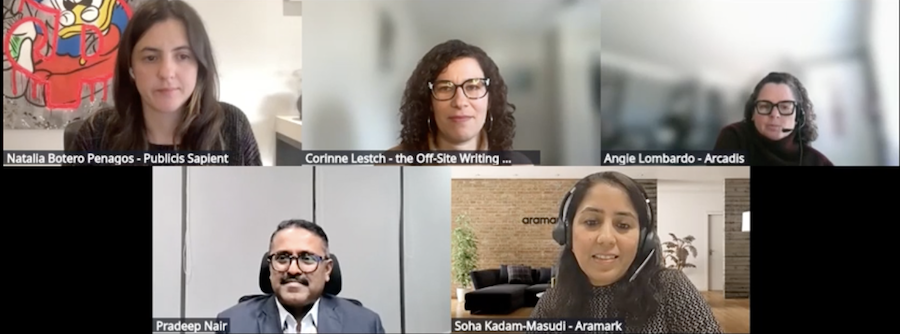
Kadam-Masudi echoed that—at Aramark (where the team recruits roughly 2,000 to 3,000 employees annually in Canada alone), AI screening tools and chatbots help manage the volume by answering candidate questions around the clock, routing applications, and reducing the administrative burden on frontline managers who would otherwise be doing a great deal of recruiting themselves. “Qualified candidates just go into the system, get interviewed, and then really the attention span for managers is: do a good job at the interview and get them hired,” she said.
Pradeep Nair, AVP, global head of TA and talent center at Collabera, summed it up neatly: “AI should remove repetition, not the responsibility.”
What’s Genuinely Useful, and What Isn’t
Not every AI tool earns its place. The panel largely agreed that the clearest value comes from tools that handle high-volume, low-complexity tasks: screening questions, scheduling, workflow analytics, candidate matching. Skill-based assessment tools—which evaluate a candidate's capacity to keep learning rather than just their resume—generated real enthusiasm, with Nair flagging them as a strong emerging category for frontline and retail roles.
Natalia Botero Penagos, senior director of talent acquisition at Publicis Sapient, pointed to an agent her team built that helps recruiters with interview preparation and candidate communications. The agent drafts messages calibrated to the company’s employer brand, at the right moment in the hiring process, and then hands them to a recruiter for a final human touch before sending. “The recruiter is the one that needs to review and add the personal touch,” she said. “It creates a more structured way of communication, a better candidate experience.”
She also highlighted Claude as a tool gaining ground, particularly for teams outside highly structured corporate environments, pointing to its ability to help build replicable skills and scale the expertise of a strong individual recruiter across an entire global team.
What the panel agreed hasn’t worked: giving AI the final say. Several leaders described experiments with fully automated decision-making for junior roles and pulling back quickly. “We were trying to get away with having AI do everything for very basic, very junior roles, and I don’t think we were comfortable to give that decision-making just yet,” Kadam-Masudi said.
Lombardo was direct about the legal and ethical stakes: “We don’t have AI making decisions. We have AI automating and making recommendations, but it definitely doesn’t make decisions, because then you get into touchy territory.”
Botero Penagos raised a point the group returned to several times: even well-designed AI agents can carry bias. The concern isn’t just about whether to hire a person, but how candidates are evaluated throughout the process. “The human in the loop is 100% needed,” she said.
That oversight isn’t just an ethical stance; it’s a structural requirement. As AI begins to shape which candidates get seen, which get screened out, and how they’re communicated with, TA leaders are increasingly responsible for auditing the system’s outputs, not just its inputs.
Early Careers in the Age of AI
One of the sharpest conversations of the session came when the topic turned to early career professionals. Chantha Nhem, global lead, new professionals, early careers global TA & development at Nokia, described a growing concern she hears from young workers: will AI take their entry-level jobs before they’ve had a chance to build the judgment those jobs are meant to develop?
Her answer was neither dismissive nor falsely reassuring. Nhem referenced Gartner research suggesting AI won’t eliminate jobs so much as reshape them; but she was candid about what that reshaping means. “There’s a loss of natural progression that’s going to happen for early professionals, where you’re going to have to have a higher starting point of complexity in your role, and the learning curve is definitely going to be steeper,” she said.
Nokia’s response has been to redesign early career programming from the ground up: shifting the emphasis from purely technical skills to adaptability, critical thinking, and decision-making, and aligning those programs directly to organizational strategy. “We have to make sure that they’re ready for this adoption and give them the confidence they need to contribute faster and integrate faster into our teams,” Nhem said. The talent acquisition and development functions at Nokia were united into a single team last April, a signal of how tightly linked the two have become.
The Judgment Calls AI Can't Make
In the session’s final stretch, Lestch asked each panelist for a recent example of a moment that required human judgment—something AI simply could not have handled.
Nhem described looking at a project status dashboard for her early careers initiative and seeing everything marked green. AI would have called it fine. She knew better: team members were quietly anxious about their shifting workloads and new skill requirements. “AI did not flag that, nor could it accommodate the needs of our team,” she said. She organized a collaborative document to surface those concerns and keep the project on track.
Nair described introducing AI tools into a recruiting workflow that had operated on Boolean searches and LinkedIn for years. The technology worked, but the people didn’t adopt it without help. “AI could analyze resumes or recommend candidates, but it couldn’t assess the readiness of people to change how they work,” he said. His team redesigned the rollout, leading with training, transparency, and success stories before asking anyone to change their habits.
Botero Penagos recalled a talent search across five Latin American countries for creative roles supporting a European team. AI helped compile data and build dashboards. What it couldn’t do was interpret the ambiguity in a creative portfolio, navigate the language and cultural nuances across six countries, or explain the complexity of the landscape to skeptical stakeholders. “All of that comes from experience and from our team,” she said.
Kadam-Masudi put it simply: even when AI hands you excellent talking points, you can’t just read them aloud. “It needs the element of you. It needs to be your kind of personality in those words. I’m still me.”
Grace Turney is a St. Louis-based writer, artist, and former librarian. See more of her work at graceturney17.wixsite.com/mysite.
(Photo by Ridofranz/iStock)