Blow Your System Up—Optimistically
BY Kristen Kwiatkowski
|
May 19, 2026

AI resistance isn't always about the tool, it’s about what the tool touches. Work is personal. Your accomplishments reflect real effort and real problem-solving. When AI enters the picture, people worry that what they built, and how they built it, might no longer matter.
“That work means something,” said Rebecca Warren, senior director, talent centered transformation, at Eightfold, during a thought leadership spotlight at From Day One’s Live Seattle conference.
It’s a fear a lot of people share: if AI can do my job, what does that mean for me? But the real truth is that the work moved. The skills didn’t disappear, but they in fact became foundational and moved underneath the AI strategy, says Warren. “AI shows up and it gets the credit or it gets the blame,” said Warren.
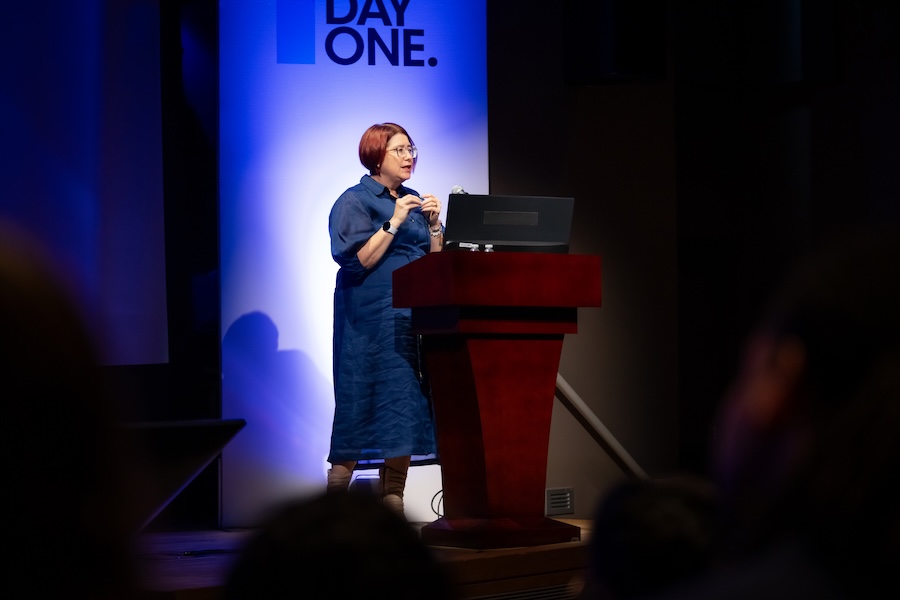
“We say we want transformation, but then we defend the exact shape of the work that created the problems we’re trying to solve,” Warren said. “AI is not the transformation. It’s the moment of truth for whether your organization is actually built to, and ready to, transform, she says.
Warren shared a “don’t pave cowpaths” example. Cows follow the same paths by habit and not because it’s the best route. Someone eventually comes along and paves the road that was traveled by habit. As a result, the bad route is permanent. “That’s what a lot of organizations are doing with AI,” said Warren. “They’re taking messy workflows, too many approvals, broken handoffs, duplicated work, and unnecessary meetings, and instead of asking, ‘Should they exist at all?’ they ask, ‘How do we automate it?’ ‘How do we make it faster?’ We just paved the cowpath. Faster wrong is still wrong.”
“AI needs to force the question, ‘Why are we doing it this way?’” said Warren. “Don’t pave cowpaths, redesign the terrain.” Transformation is about what work survives. “Not everything is broken and not everything new is better, but the key is knowing the difference,” Warren said.
It’s important to know when AI should be part of the conversation and when a human component is needed. For example, AI can handle administrative tasks, but there are times when human decision-making is essential, especially when ethics, trust, and nuance are involved. That’s where human judgment truly matters.
In order for trust to occur, transparency must be present. People have to understand what’s changing and why. Without this, people build assumptions. “That’s why this is hard, and honestly, that’s good,” said Warren. “It should be hard because we’re not talking about buying a piece of software, we’re talking about redesigning how work moves, what people do, where to partner with AI, and what to change. That should feel heavy, that should slow you down, because sometimes the fastest way forward is to stop and ask what would need to be true for this to actually work.”
It’s important to “slow down, build the guardrails, build the infrastructure, clarify the decision rights, and then move fast, not because caution is weakness, but because speed without design is just faster chaos,” said Warren.
Editor’s note: From Day One thanks our partner, Eightfold, for sponsoring this thought leadership spotlight.
Kristen Kwiatkowski is a professional freelance writer covering a wide array of industries, with a focus on food and beverage and business. Her work has been featured in the Bucks County Herald, Eater Philly, Edible Lehigh Valley, Cider Culture, and The Town Dish.
(Photos by Josh Larson for From Day One)