Leading Through Digital Transformation: Redesigning Work and Keeping People Connected
BY Grace Turney
|
May 18, 2026

Todd Reeves spent years running payroll early in his HR career. “Don’t ever do that,” he joked to the audience at From Day One’s Seattle conference. “There’s no good outcome other than perfection in payroll.”
The joke landed, but it also illustrated something true about the function Reeves now leads at the highest level. Human resources has long been defined by operational precision, by getting the details exactly right. What Reeves, chief people officer at Zoom, described in his fireside chat was a profession on the cusp of shedding much of that burden entirely.
The conversation, moderated by Megan Ulu-Lani Boyanton, business reporter for the Seattle Times, covered Zoom’s pandemic-era transformation, its evolving AI strategy, and what it means to lead a global workforce through a period of relentless technological change.
From Video Calls to Completed Work
Zoom turns 15 this year, and Reeves is quick to note how much the company’s ambitions have expanded since its founding. “We started out with the mission of just making video communications easy, accessible, and simple,” he said. Today, the company is focused on something it calls “C to C to C,” conversation to completion.
The idea is that AI can turn the things people say in meetings into action, without anyone having to follow up. Reeves offered a simple example: if someone in a call says they want to schedule a meeting, it’s already on the calendar before the call ends. A request to send a proposal might generate a draft presentation on the spot. “How do we make that conversation turn into work during the meeting, shortly thereafter, or provide intelligence for you to use later on?” he said. “It’s a real transformation.”
The Pandemic’s Lasting Imprint
No conversation with a Zoom executive sidesteps Covid. The company tripled in size within 24 months of the pandemic’s onset, expanding from an enterprise-focused platform to a tool used for weddings, parliamentary sessions, and school classrooms around the world.
Reeves wasn’t at Zoom during that period, but the culture it forged is one he inherited and described with evident pride. When schools scrambled to shift to online learning, Zoom’s CEO Eric Yuan made the decision to distribute licenses to 125,000 schools globally, at no charge. “That’s emblematic of how we think about Zoom and what we do for the community,” Reeves said.
The operational intensity of those years also left its mark. A bias toward speed and a low tolerance for bureaucracy became embedded in the company’s culture, and Reeves said both remain defining traits today.
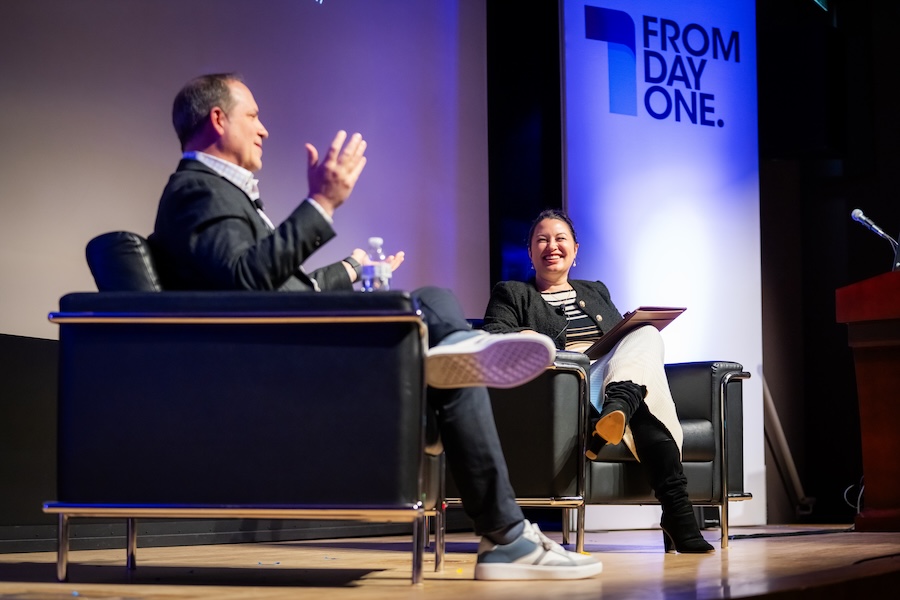
Boyanton asked Reeves about competition in this changing space, not just from Microsoft Teams, but from the expanding universe of AI companies entering the communications space. His answer pointed to three areas where Zoom believes it has an edge.
The first is ease of use, a principle the company treats as a core competency rather than a feature. The second is AI capability: Zoom uses what Reeves described as a federated AI model, selecting from among the best available AI systems depending on what a user needs, an approach he said has produced top scores on rigorous academic benchmarks. The third, and perhaps most durable, is context. Because so much workplace communication runs through Zoom, the platform accumulates a rich layer of conversational data that can power AI tools in ways a newer entrant can’t replicate.
The Future of HR
When Boyanton asked where the HR profession is headed, Reeves didn’t hedge. He sees much of the transactional work of HR, such as tier-one employee support, routine queries, and administrative processes, being fully automated within five years. Zoom is already redesigning its internal knowledge base to be read by AI, and he expects a conversational HR chatbot to absorb 20 to 30 percent of his team’s workload.
What remains, he says, is the work that genuinely requires a human: talent strategy, organizational design, leadership development, employee relations, culture. “Spend more time on the parts of the job that really require a human to influence and be a factor,” he said. “The other things will get taken care of.”
The advice extended to how HR leaders make decisions in general. Reeves described himself as a data convert: someone who has learned to bring numbers and evidence into discussions that typically run on opinion and intuition. When a recent internal policy debate arose, he asked how many employees it would actually affect. The answer was 12. “I said, okay, then I think we can make a simple decision around this.”
Even without formal metrics, he encouraged his team to find ways to gather information. Talk to 20 employees, run a small experiment. “There are ways to get data even if you don’t feel like you have the specific metric.”
Connection in a Changing World
When Boyanton asked how Zoom manages its worldwide workforce, spanning R&D teams in China and India, sales organizations across multiple continents, and employees in dozens of time zones, Reeves answered with a laugh: “We use Zoom.”
The practical answer was more layered. He described a design philosophy built around local, intact teams that can operate largely independently, without requiring a manager on the other side of the globe to make decisions. Clear goals, recorded meetings, and accessible documentation help overcome the obstacle of distance. And as a leader, he said, accessibility has to be intentional: he runs town halls in the evening and again in the morning to make sure employees across regions can participate.
The session ended with an audience question about keeping teams meaningfully connected amid constant noise and digital overload. Reeves’ answer was simple: don’t overcomplicate it.
Have a team meeting. Start with something enjoyable. Make room for humor. The nature of work will keep changing, he said, but people are still people—-trying to solve problems together, trying to connect.
“Have some fun,” he said. “Remember the Zoom happy hour chats? Just do stuff like that. And I think everyone will be fine.”
Grace Turney is a St. Louis-based writer, artist, and former librarian. See more of her work at graceturney17.wixsite.com/mysite.
(Photos by Josh Larson for From Day One)