Accelerating L&D With AI: How to Lead, Adapt, and Keep the Human Touch
BY Katie Chambers
|
December 17, 2025

Nearly 60% of HR leaders say AI adoption is one of their biggest challenges, yet the prospect of radically improving worker learning and development is a huge new opportunity.
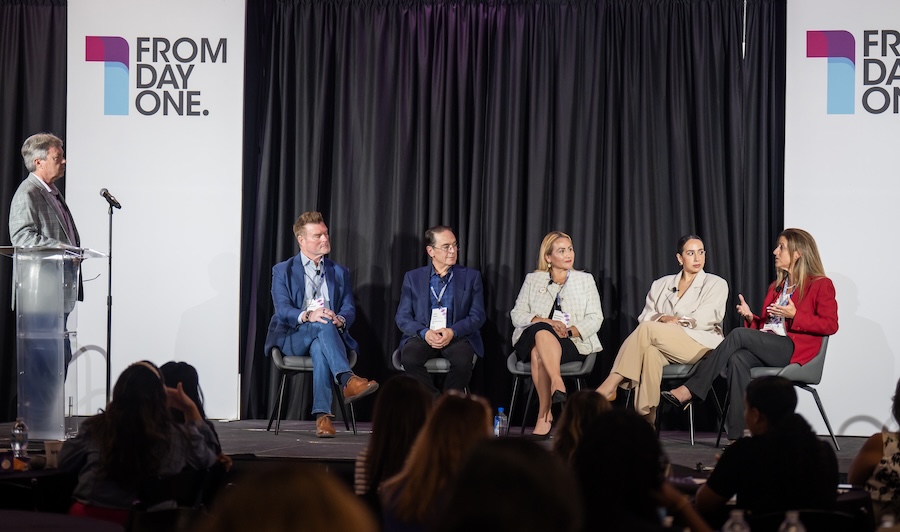
How can AI make L&D more individualized, efficient to produce, and integrated with the flow of work? Can it upskill workers more quickly than traditional methods and accelerate leadership development? Leaders shared their ideas on the subject during a panel discussion titled, “Accelerating L&D With AI: How to Lead, Adapt, and Keep the Human Touch,” at From Day One’s Miami conference.
“The best companies in the world that are going to develop through this phase are the ones that train their people to use AI most effectively, not be scared of it, and embrace it,” said Dave Coldwell, global AI executive at Cisco. But that’s easier said than done. “With AI, like any new technology, there is some apprehension, and we all know that it’s a tool. It’s not human,” said moderator Paul Bomberger, independent journalist and former Miami Herald business editor.
Leaders must maintain human connections with their teams while rolling out emerging technologies, and emphasize that these tools will never replace human workers—just augment them. “It doesn’t have innovation. It is good at giving you resources and instructions, but there’s the human aspect that we need too,” said Elyse Sitomer, learning & organizational development partner at Memorial Healthcare System.
It can be hard to get “old school” industry leaders to get on board with the AI revolution. Alexandra Bautista, SVP of employee experience at Harvard Services Group, said the key is “helping them understand that it’s a tool to leverage your performance.” She has brought in speakers to share how AI can make the workday easier and reinforce that it’s a positive rather than something to be feared.
Panelists suggest rolling out simple tools like Microsoft Copilot or ChatGPT to get your general workforce more comfortable with artificial intelligence. These tools can simplify administrative tasks by summarizing email chains, creating agendas, or taking notes at meetings.
From there, more complex AI educational software packages are no longer one-size-fits-all, but highly individualized, says Chris Narmi, chief strategist, AI and workflow at HP. These tools “recognize the strengths and weaknesses of an individual, track them through their learning process and customize their learning program.” And the training is often built in. “AI is unique in that it’s the first technology that can really teach you how to use it.”
Innovative Uses for AI in the Workplace
Gone are days of lengthy employee handbooks or boring onboarding videos. “What generative AI has allowed us to do at Cisco is personalize the training. [We have] the right training for the right people at the right time, and that’s led to developments in leadership, developments in creativity, and exponentially improv[ed] our salespeople’s engagement with the customers and partners that they’re dealing with on a day-to-day basis,” Coldwell said.
“The thing that’s uniquely human is intuition, empathy, and purpose, which we don’t have just by using AI alone.” His organization has developed its own AI model, called Circuit, used by its 20,000 salespeople. “Instead of replacing people, it’s actually helping to skill up our new employees, but also for our existing employees, it’s helping empower them to be better.”
Maria-Pia Barbona, VP of HR at Swatch Group, shares that in her previous role at LVMH, her team worked with tools like Yoodli, an AI speaking coach that let salespeople roleplay customer interactions. “You prompt your AI, you go into a FaceTime call with your AI, and there’s a person that you see there and you go in a roleplay,” she said. The platform lets associates practice difficult conversations and refine their techniques to make a sale. Managers were able to log in to see results, which helped them discover trends as to which areas required further training.
Narmi cautions that AI can provide solutions to customer issues, “but it lacks the empathy to understand the applicability of those answers, and you’ll learn that you need to apply your own judgment. The human piece is applying that [artificial] intelligence appropriately under a set of circumstances.” He advises engaging in active dialogue with AI to hone its answers, guiding it with your own human emotion and intuition. “I find it a collaborative process: it learns from me and gets better.”
AI works best when it’s breaking down large swaths of information, providing summaries, and giving detailed explanations. Then you need to synthesize all of it in the complex, innovative, and nuanced ways that AI can’t. “I like AI for its immediacy. It gets the hard work out of the way,” Sitomer said.
Narmi shares that he has developed a fleet of AI agents through Copilot to help him optimize his performance. “I have an executive assistant. I have an editor. I have a white paper writer.”
At Harvard Services Group, Bautista and her team create GPTs that offer a customized learning path for new hires during the first 30, 60, and 90 days of their employment, creating a “learning culture” at the organization that did not previously exist. “We’re taking it to the next level, starting next year, and customizing based on performance conversations with the managers. Where are those skills gaps that this person may have? Do we want to get them to the next level? If so, what are the competencies that they need to have?” she said. Employee retention is the goal. “I think there’s no other way to tell our employees that we care than to tell them we see you. We want to develop you. We want you to grow.”
Narmi advises that leaders remember that AI is just a tool; an organization’s biggest asset is still its human workforce. “Recognize that your talent, and the fundamental talent of the people that work for you, is imagination. You need to foster imagination and help people to understand that AI cannot perform that role,” he said. “Let it do the research but let people use their imagination with the AI to expand [their] ideas.”
Or, as Coldwell put it, “AI is for speed. People are for direction.”
Katie Chambers is a freelance writer and award-winning communications executive with a lifelong commitment to supporting artists and advocating for inclusion. Her work has been seen in HuffPost, Top Think, and several printed essay collections, and she has appeared on Cheddar News, iWomanTV, On New Jersey, and CBS New York.
(Photos by Josh Larson for From Day One)


