AI in HR: How Work, Skills, and Leadership Evolve in a New Tech Era
BY Emily McCrary-Ruiz-Esparza
|
December 17, 2025

A year ago, HR leaders approached artificial intelligence with trepidation, afraid to jump in first, lest they also be the first to make a mistake. “That really changed overnight,” said Adam Vassar, head of talent science and learning design at skills evaluation platform CodeSignal.
Early adopters follow a familiar pattern: automating the top of the recruiting funnel or using AI to assess technical skills like coding. Today, the use cases are broader and more varied. Vassar now works with clients to evaluate employees–technical and non-technical alike–on generative AI literacy, role-specific AI proficiency, and understanding of the technology’s limitations.
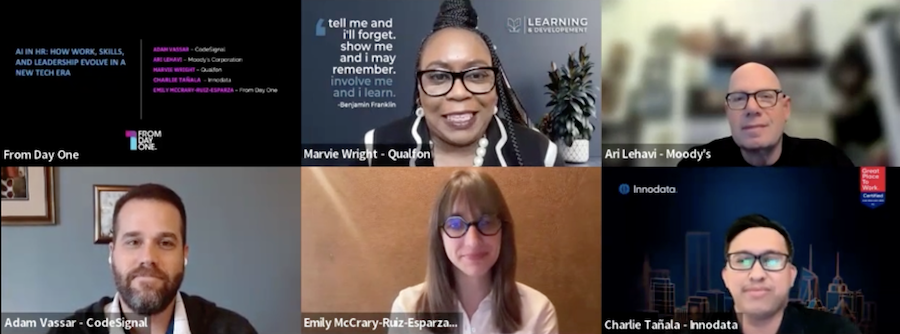
Vassar and his fellow panelists discussed how AI is reshaping jobs, and how HR is helping to manage that shift, during a From Day One webinar on how work, skills, and leadership are evolving in the age of AI.
“But before we can evaluate candidates on the AI skills they need or target the skills employees need to develop, we have to redefine skills taxonomies and job architecture,” Vassar said.
That’s the work currently underway at data engineering firm Innodata, says Charlie Tañala, head of talent, capability development, and employee experience. “The foundation is clarity,” Tañala said. “You need a skills taxonomy that reflects the work your organization actually does.” The project, launched less than a year ago, will undergird Innodata’s internal skills marketplace, enabling the company respond more quickly to client needs and employees to move fluidly within the organization.
Innodata accelerated its focus on AI skills as it gained a wave of AI-proficient clients, and their existing client base was quickly catching up. “We started supporting customers who build and refine generative AI models, and the expectations moved to a different level,” Tañala said. “The skills required in generative AI workflows are more specialized and more judgment-heavy. We had to rethink almost everything–how we attract talent, how we design roles, and how we structure teams.”
What AI skills a workforce needs will vary by company and function, says Marvie Wright, the VP of HR at customer service provider Qualfon. “Spend time in discovery to understand what’s out there,” she said. “Then tailor that to your organizational needs, being aware of what gaps you have, and how would you like for an AI to fulfill those.”
AI is being applied differently in finance than in, say, communications or IT, prompting employers to think more deliberately about how skills are developed across functions. At Qualfon, a cross-functional task force evaluates and sets expectations for AI skills by department. “We know this is leading to a more enhanced future,” Wright said. “It’s really exciting, and it’s going to change the educational forefront of the workplace as well.”
Identifying and measuring skills is only part of the equation. Training is another. “You want hands-on experience to see what’s possible, explore the edges, and understand where the logic breaks down,” said Ari Lehavi, head of applied AI at credit ratings institution Moody’s. He favors group workshops that demonstrate what’s so satisfying about AI, which is the ability to go from zero to prototype in hours.
Participants collaborate–bolstered by AI–to solve real problems, moving from concept to execution. “I like to see how different people come up with ideas,” Lehavi said. “You help when they struggle, and, typically, you end up with some great ideas,” he said. “Everybody builds something, and they get very proud. That whole element of fear and the unknown dissipates, and they can venture into new ways of operating.”
Wright advocates for as personalized an approach as possible. “We look at their individual needs, their gaps, and their progressions, then tailor individual approaches for each one very quickly and very accurately,” she said. As Qualfon has intensified its efforts, the returns have come faster. “We love it. We’re obsessed with it right now.”
For Tañala, it all comes back to adaptability. “The skills we rely on today can change quickly,” he said. “Our people need the confidence to adjust without feeling lost. AI readiness is about understanding how to work with AI—and how to make good decisions with what it produces.”
Editor’s note: From Day One thanks our partner, CodeSignal, for sponsoring this webinar.
Emily McCrary-Ruiz-Esparza is an independent journalist and From Day One contributing editor who writes about business and the world of work. Her work has appeared in the Economist, the BBC, The Washington Post, Inc., and Business Insider, among others. She is the recipient of a Virginia Press Association award for business and financial journalism. She is the host of How to Be Anything, the podcast about people with unusual jobs.
(Photo by Harsa Maduranga/iStock)


