The Rules Are Being Rewritten: How Bold Leaders Win in the AI Era
BY Ade Akin
|
December 22, 2025

The time between technological revolutions has shrunk from 50 years to a couple of decades, and AI is now rewriting what work looks like faster than organizations can adapt. The rapid pace of new technologies that significantly impact how companies operate is creating massive skill gaps that traditional hiring and training methods are ineffective at addressing.
Recruiting and learning divisions within organizations are now coming together to improve talent acquisition and address skill gaps from within. Tigran Sloyan, the CEO and co-founder of CodeSignal, urges companies to move beyond passive learning and resume screening, and embrace AI-powered, hands-on learning programs and scalable assessments.
“You want to answer the question, ‘What can we do? How can we leverage this, and how can it be good for humanity?’” Sloyan said during a thought leadership spotlight at From Day One’s LA conference.
The Historical Pace of Change And Why This Time Is Different
Sloyan started his presentation by comparing the speed of technological breakthroughs since the development of the internet to the pace of tech advancement several centuries ago, when the printing press was invented.
“It used to take us 50 years to experience a new, dramatic technological shift,” he said. “Forty years ago, we didn’t have web developers. Thirty years ago, we didn’t have cloud engineers. Twenty years ago, we didn’t have mobile engineers.” Each shift created new jobs and skills, but organizations had more time to adapt.
Today, generative AI tools like ChatGPT, which has only been around for a few years, are transforming workplaces, garnering over 700 million active weekly users. Sloyan says the challenge is leveraging new technologies like AI to “transform how we find, discover, and develop skills that will shape this future.”
Closing Skills Gaps With Hands-On, AI-Powered Learning
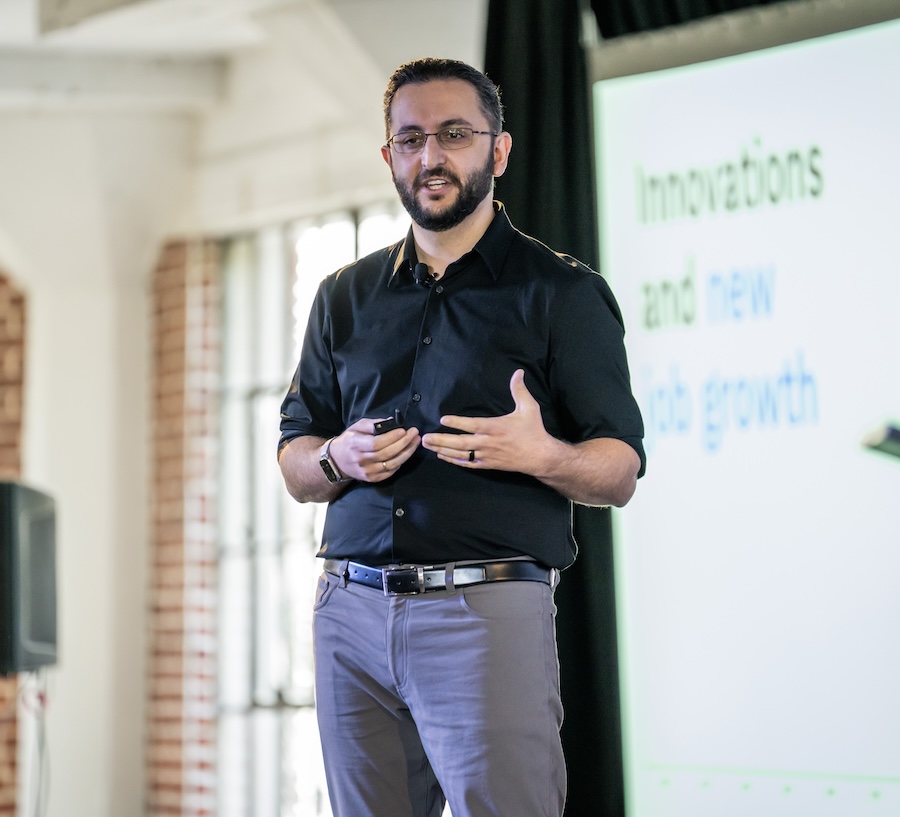
Sloyan introduced CodeSignal as an “AI-native skills intelligence platform” built on the principle that people learn best when performing tasks. “Think about when you learn how to ride a bike, how you learn to drive a car. You get behind the wheel, and you actually try and practice,” he said. The same applies to job skills, but scaling hands-on learning programs has historically been challenging.
Sloyan shared the example of Dropbox, which faced considerable AI skill gaps across its workforce. Dropbox’s executives recognized it couldn’t hire its way out of its problem because the skills required were too new to be widely available. The solution was to partner with CodeSignal to build a Gen AI Skills Academy.
The academy offers employees three options: AI use lessons for non-technical roles like marketing, AI integration classes for building products using existing tools, and AI creation courses that teach how to build new AI systems.
Sloyan says the key to the success of Dropbox’s Gen AI Skills Academy is its practice-based nature. He demonstrated a model where learners first practice prompting an AI model, then are tasked with teaching a simulated coworker named “Nova” how to do it. “Another way you learn well is by teaching other people,” he said.
CodeSignal’s AI doesn’t only simulate conversations, it also provides personalized feedback through its “Cosmo” system. “Practice without feedback is not very helpful,” Sloyan said, comparing it to learning to drive a vehicle without an instructor. “With generative AI, we’re making it possible to actually scale this to an entire organization.” Dropbox applied this to thousands of employees, enabling them to learn, practice, and get feedback at scale.
How AI Interviewers Are Opening Up the Hiring Funnel
Sloyan also shared how Coinbase created a more efficient hiring process thanks to CodeSignal’s AI interviewers that scale top-of-funnel recruiter screens to nearly 100% of its candidate pool. Coinbase had previously struggled sorting through a flood of applicants with its limited recruiting team, leading to as many as 95% of job applicants never hearing back from a human.
“Almost every candidate that applies actually hears back and actually gets to have a conversation to talk about their skills,” Sloyan said. He showed a demo of “Milo,” an AI interviewer CodeSignal uses in its hiring process, interviewing a candidate.
A common concern is that AI interviews might feel impersonal, but Sloyan says candidate feedback has been overwhelmingly positive. “Candidates are saying, ‘This is one of the best interviews that I’ve actually done,’” he said. The AI can be customized for tone to align with an organization’s legal and brand guidelines.
Sloyan says the next step is moving toward AI avatars to create an even more immersive experience. He playfully demonstrated the concept with a candidate interview conducted by an AI avatar of Santa for an “elf” position.
A Future Built on Skills, Not Just Credentials
Sloyan kept returning to a central theme during his presentation: The future belongs to organizations that can discover and develop new skills proactively. AI is the accelerant, but the solution is timeless; learning by performing tasks reinforced by feedback. It’s the necessary response to a world where new jobs are created by new technologies every decade.
“Technology keeps on moving faster and faster. Humans do not,” Sloyan said. “We’re still the same humans, and it’s this technology that needs to help us go through this process faster and be on the winning side of history.”
Editor’s note: From Day One thanks our partner, CodeSignal, for sponsoring this thought leadership spotlight.
Ade Akin covers artificial intelligence, workplace wellness, HR trends, and digital health solutions.
(Photos by Josh Larson for From Day One)


