Future-Proofing Benefits For A New Generation
BY Ade Akin
|
April 10, 2026

Claire Morrow had just stepped out of a driverless car in San Francisco when her smartphone buzzed with an urgent referral from her doctor.
Two weeks earlier, Morrow, who was training for a marathon, had taken three six-hour flights in four days when her knee began to ache and swell. Her doctor ordered an immediate ultrasound to determine if her flare-up was the result of running or a blood clot caused by sitting in a pressurized cabin for 18 hours. When Morrow called the hospital to schedule the scan, the response was “fax us the details.”
“I guess this really was shocking to me,” Morrow, the head of clinical consulting at Hinge Health, shared during a thought leadership spotlight at From Day One’s half-day NYC benefits conference. “I’m riding in a driverless car, but I still need to own a fax machine. This doesn’t make sense.”
The contrast captures the central challenge facing HR and benefits leaders today. Millennials and Gen Z now make up over 50% of the workforce as workforce demographics shift dramatically. That figure is projected to reach 74% by 2030 as employee expectations collide with healthcare systems still reliant on fax machines and CD-ROMs.
The New Generation’s Healthcare Expectations
Millennials and Gen Z generally expect a fundamentally different healthcare experience. They grew up Googling their symptoms before consulting with doctors, and want seamless digital access, remote communication with providers, online scheduling, and the flexibility to choose between in-person and virtual care.
“Before I was at Hinge Health, I spent four years as a physical therapist at the on-site clinic at Google,” she said. “For every exercise I gave them, they would say, ‘What is this exercise doing for me? Don’t you think I have this diagnosis?’ They had obviously already Googled their condition.” She notes that this trend has intensified with the rise of AI tools: “It’s not just Google anymore. It’s ChatGPT and other AI tools that they’re also using for that.”
The Fragmentation Problem
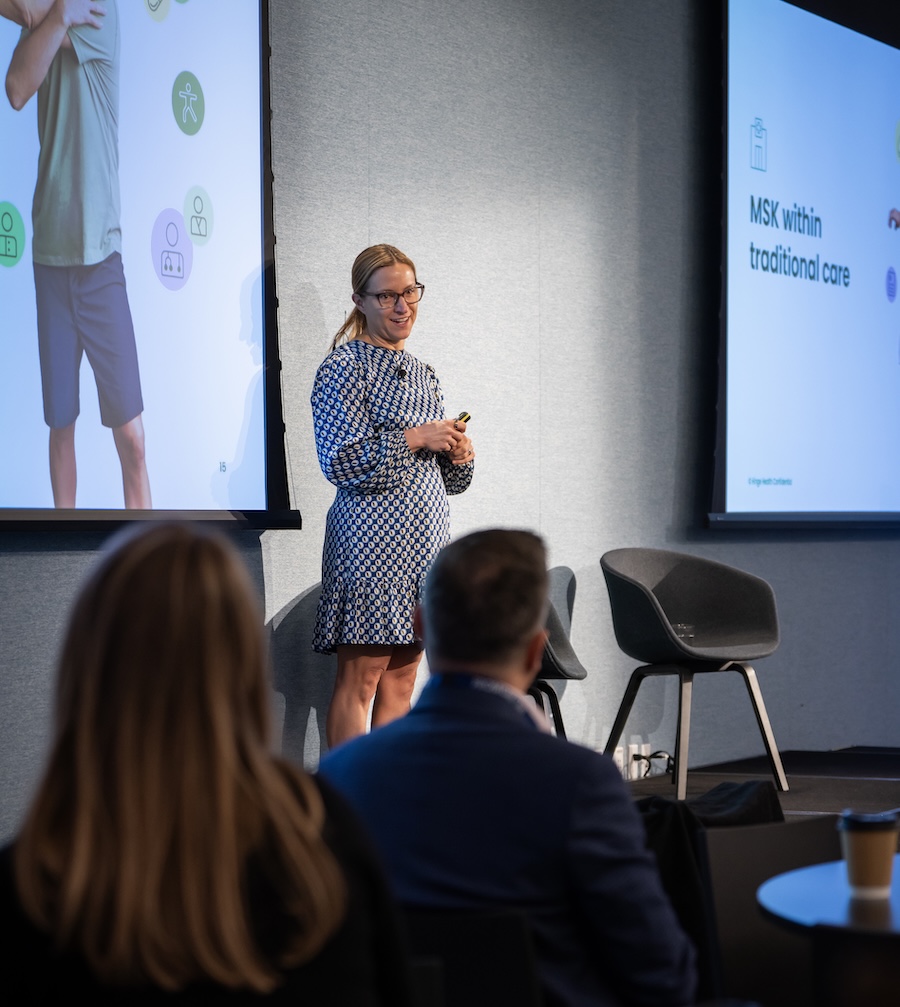
The healthcare industry remains stubbornly fragmented despite the tremendous technological leaps that have occurred in other industries. Morrow illustrates the problem with a personal story about a knee injury her husband suffered.
“He was running when a German Shepherd ran into the side of his knee, dislocating his kneecap,” she said. The injury led to an odyssey through the system: urgent care, a two-week wait for an orthopedist, imaging at one facility, and physically picking up a CD of the MRI to bring it to a surgeon at another hospital.
“The rest of the world is moving forward, and we need to think about moving forward with the rest of the world,” she said. “Surgery and medications are often still chosen as quick fixes, but MSK [musculoskeletal] care can be incomplete. We tend not to always think about the whole person.”
The Shift to Unified Care
Morrow has watched the digital health revolution unfold as a physical therapist for over 13 years, including six years spent at Hinge Health. Digital tools now make it possible for patients in rural areas to rehab after knee replacement surgery without having to drive 45 minutes to a clinic in some city twice a week.
However, the technological revolution has also created new problems, such as silos between digital and in-person care.
“We need to move from fragmented care to unified care,” she said. “I can’t believe I’m saying that’s the future, that we’ll all talk to each other, because it almost seems obvious. But we really need to choose digital solutions and healthcare solutions that speak to each other.”
She says a unified care model would provide a digital front door where members can connect with care coordinators who can triage their condition, provide recommendations, and make warm handoffs to pre-vetted providers, digital or in-person.
AI as the Enabler, Not the Replacement
AI is being deployed at Hinge Health to automate tasks to free up clinicians so they can focus more on connecting with patients.
“We have an AI-powered care team assistant that we're naming Robin,” she said. “There’s an art to naming your AI agents, and I think we nailed it.” Robin can triage pain flare-ups, gather information, and summarize it for physical therapists, reducing response times from days to same-day care plan adjustments. The automation has improved care team response times by 47%.
“Our goal is to ensure that our highly skilled care teams have the time to provide the skill and compassion needed to support each member’s needs," she said. “We’re not replacing that in-person experience. We’re enabling it.”
The company’s TrueMotion technology uses computer vision to guide members through exercises, while a recently launched movement analysis tool uses augmented reality to measure the range of motion in the lower back.
“We’re starting to replicate some of those interactions from in-person care,” Morrow said. “That doesn’t mean we’re replacing that connection. We’re just making it so that the time a member is not with a physical therapist is much more meaningful.”
Future-Proofing Benefits
Morrow’s recommendation for HR leaders looking to future-proof benefits packages is to embrace unified care models that meet the expectations of a digital native workforce.
“You’re empowering members. They’re able to get information and make their own decisions,” she added. “You’re building trust in AI. This is really where the future is going. AI has tremendous potential for healthcare, but we need to build that trust.”
The transition won’t happen overnight, but as Morrow says, the alternative—continuing to rely on fax machines while employees expect driverless cars—isn’t really an option.
Editor’s note: From Day One thanks our partner, Hinge Health, for sponsoring this thought leadership spotlight.
Ade Akin covers artificial intelligence, workplace wellness, HR trends, and digital health solutions.
(Photos by Josh Larson for From Day One)