Building Benefits That Balance Cost Efficiency With Employee Outcomes
BY Jessica Swenson
|
April 15, 2026

As healthcare and benefits costs continue to rise, organizations are under increasing pressure to cut spending while maintaining the employee experience. Jordan Dhillon, VP of sales for SmithRx, suggests that one way to drive cost efficiency is to explore alternative partners and start benefit evaluations early.
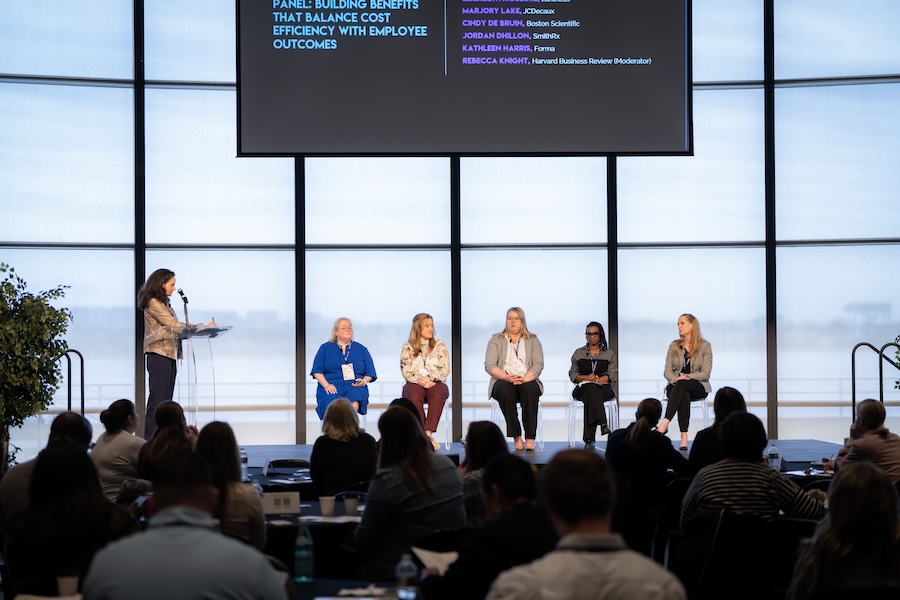
“Don’t be afraid to have the conversation. Look for the long-term partner that’s aligned with your model and your values, and start the process early,” she said during an executive panel discussion at From Day One’s Boston benefits conference. Dhillon spoke on a panel with four other leaders, moderated by Harvard Business Review contributing columnist Rebecca Knight.
Evaluating Benefits Programs
To balance utilization, cost, and vendors within your benefits programming, Elizabeth McClure, head of benefits for Lantheus, endorses a full audit approach focused on refining and streamlining your offerings. She recommends looking at utilization rates to determine high-value benefits, and maximizing impact by consolidating duplicative services provided by multiple vendors. “I think it was important to go through and get the full picture of what employees value, and how we can really focus on those [things].”
While ROI is of course a critical part of the decision-making process, Kathleen Harris, head of consultant relations & strategic programs at Forma, emphasized that overreliance on ROI can detract from benefits that are valuable for overall culture even with limited direct use. She told the story of the company’s on-site daycare; it can only serve 250 families out of Forma’s nearly 1,000 employees, but employees across the spectrum are proud to say that they have on-site daycare. She calls this a halo benefit.
Harris also cautioned against fragmented evaluation of benefits. “Sometimes we talk about the ecosystem, but then we also look at things in a silo. So we’re not looking at it across, we’re looking at it vertically, in terms of what we’re offering our employees.” Between this siloed view and failing to incorporate employee feedback, companies can wind up with lower-value, fragmented benefit plans.
The lack of fiduciary alignment in traditional pharmacy benefit managers (PBMs) can be a hidden cause of overspending, says Dhillon. She advocates for partnering with independent PBMs that focus on lower drug costs, transparent pricing, and patient-first outcomes, aligning themselves with employer and employee needs. “I would say you need to find a partner that’s independent and that is operating in your best interest as a fiduciary,” said Dhillon.
Inclusion in Benefits Design
Marjory Lake, head of total rewards & people operations at JCDecaux, suggests that companies consolidate vendors, continuously listen to employees to meet them where they are, and design benefits programming for real-life employee needs.
JCDecaux recently combined healthcare savings accounts and 401(k) accounts into the same vendor, saving the company money while improving the employee experience, she says.
Lake looks at employee benefits holistically to ensure the company is meeting the needs of most employees. “I want to look at something that’s more impactful and more meaningful. That way [you can get] that buy-in for the higher ups, but also you’re meeting people in the middle of where they are in their lives.”
Aside from the simple shifting of costs, companies are finding innovative ways to provide value. Harris advocated for lifestyle spending accounts (LSAs) as a core requirement to address the diverse, evolving needs of today’s workforce. She discussed their ability to complement traditional benefit plans by bridging gaps for things like caregiving education, and counseling that are otherwise not covered.
The advent of GLP-1 medications for weight loss has created a new benefit-cost challenge for companies, panelists agreed. “What we really focus on is that supportive ecosystem around all of these things. We want to partner with lifestyle vendors and offer these things like gym memberships and other pathways to meet people in the middle,” said Lake. “A healthier and happier workforce will, over time, pay it for itself.”
Cindy de Bruin, senior director of benefits and global mobility for Boston Scientific Corp., highlighted the company’s Surgery Center of Excellence, which routes certain procedures through a curated provider network with the goal of lower costs, improved outcomes, and shortened recovery times.
However, the workforce had a strong, unexpected reaction to the change, leading the company to realize that they needed better communication. “We had to explain that part of this is not just about cost—this is also about your benefit. This is also about all our employees across the U.S..”
Communication as a Strategy
Not surprisingly, the need for communication and employee listening around benefits programming emerged as a common theme. Employees need to understand why changes are happening, says Dhillon, or you can run into resistance and engagement issues. “The more you can communicate, the more you can educate your employees as to why we’re doing this—I think it’s powerful, and that’s where I see the most success, honestly.”
Communication gaps can impact employees’ awareness of what is available to them. Vendors can help them navigate benefits, says de Bruin, but first there needs to be communication from the employer. “If we do listening sessions, for example, we sometimes hear of benefits that they would like to have offered that are already there. That means we are doing something wrong in the communication.” she said.
To help neutralize lack of awareness or slow benefit uptake, Harris recommends multifaceted communications and repeated exposure to visual cues alongside traditional communication campaigns. Using an established color-coded system that categorizes company benefits, Forma draws attention to specific offerings or benefits by adapting its intranet site during seasonal awareness campaigns, but still sends a notification postcard to employees’ homes to notify them of actions like benefits enrollment.
McClure achieved a 90% response rate on a recent employee survey by clearly communicating the purpose, “to make informed decisions moving forward,” ensuring anonymity, and allowing open-text responses. Employees are given the message that “this is your big chance to get out everything you want to get out,” she said, “because it’s so valuable [for the company] to hear this feedback.”
In that survey, they “had 95% of people say that they rated benefits as the most important thing when determining whether they’re going to get a new job or stay at the one they’re at.” Armed with this employee data, she is able to keep leaders focused on the big picture and avoid quick fixes that could have negative long-term financial implications.
Additionally, it’s crucial to balance vocal employee preferences with what is best for most employees, says Lake. “Our job is to always look at the equity—what the greater good is, what the need is,” she said. “The goal is to build a foundation that supports everyone. That’s not always easy, because everyone has different needs at different times, and they’re in different places in their lives.”
Jessica Swenson is a freelance writer and proofreader based in the Midwest. Learn more about her at jmswensonllc.com.
(Photos by Josh Larson for From Day One)