Hiring Effectively in a Resource-Constrained World
BY Emily McCrary-Ruiz-Esparza
|
June 30, 2026

Despite the term “skills-based” being a regular part of HR parlance for the last three years, most companies are still trying to figure out what that means for their organization.
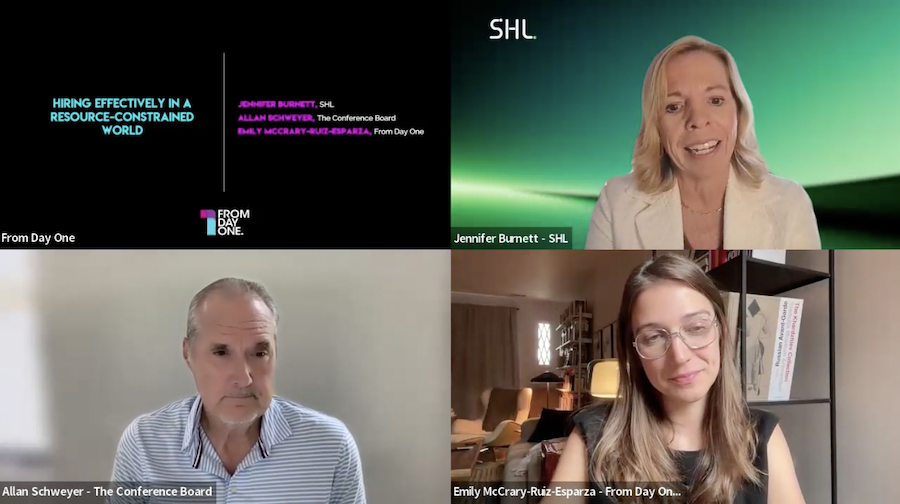
Not all companies need to become a skills-based workforce, says Jennifer Burnett, an organizational psychologist and principal solutions architect at talent assessment technology platform SHL. But for large companies that struggle to define and find the talent they need, within the organization and without, it can be hugely beneficial.
“Being a skills-based organization probably speaks more to the complexity of the organization, the maturity of their talent practices, and the role diversity,” she said during a From Day One webinar. Those with smaller workforce or with fewer role types may not find much use for a skills-based strategy.
The good thing is, skills are “the common data element we’ve been looking for for a very long time in the HR and talent space,” Burnett said. But frankly, this isn’t something that “makes life easier from an HR or talent practice perspective.” This is a business initiative HR is uniquely equipped to support.
Most organizations that have adopted a skills-based strategy have incorporated it into workforce planning or into hiring, and some might have applied it to learning and development, “but very few have linked it all together in a cycle, so it hasn’t produced a clean ROI yet,” said Allan Schweyer, principal researcher of the human capital arm of The Conference Board, a non-profit think tank that collects and analyzes data for influential enterprises around the world.
But there are early signs. Some companies report faster time-to-hire, while others tout internal mobility or increased engagement, he said. As for greater ROI, that will just take time. The practice hasn’t matured enough.
Companies that succeed in operationalizing skills start small, usually with job descriptions, which can be easily governed, recorded, and replicated. “When you do start with hiring,” Schweyer said, “you’re forced to build a skills infrastructure, a skills library, job architectures, and assessment methods.” From there, employees can build skills profiles, the business can set up internal talent marketplaces, and both can work together on career pathing.
Hiring today remains very resume-based, said Burnett, “and we often go from screening resumes into interviews where you’re trying to collect as much information with a variety of interviewers. When it’s a skills-based process, you put an objective assessment between the screening and the interviews. That can help you ask more targeted interview questions.”
On the day a new hire shows up for work, you already know their strengths and what needs developing. “In traditional hiring, we don’t have that insight,” she said. “A lot of that information just stayed in the talent acquisition process.” This bleeds into learning and development, then promotions and internal mobility, compensation, and workforce planning more broadly.
It takes more than a mandate from on high to make this work, they said. “Companies who are more mature in this space have shared with us that they underestimated the change in behaviors and mindsets required to make this shift,” Burnett said. Managers must balance data against subjective judgements they’re more accustomed to, and there’s more required from employees too, who need to keep their talent profiles up to date.
Employees benefit from autonomy. “They’re actually involved in their own development and in identifying their next role,” she said. “That change in thinking—of talent as more versatile and longer-term,” that means that the company is making an investment in the employees, and in turn, the employee is making an investment in the company.
Editor’s note: From Day One thanks our partner, SHL, for sponsoring this webinar.
Emily McCrary-Ruiz-Esparza is an independent journalist and From Day One contributing editor who writes about business and the world of work. Her work has appeared in the Economist, the BBC, The Washington Post, Inc., and Business Insider, among others. She is the recipient of a Virginia Press Association award for business and financial journalism. She is the host of How to Be Anything, the podcast about people with unusual jobs.
(Photo by ABRAHAM GONZALEZ FERNANDEZ/iStock)